


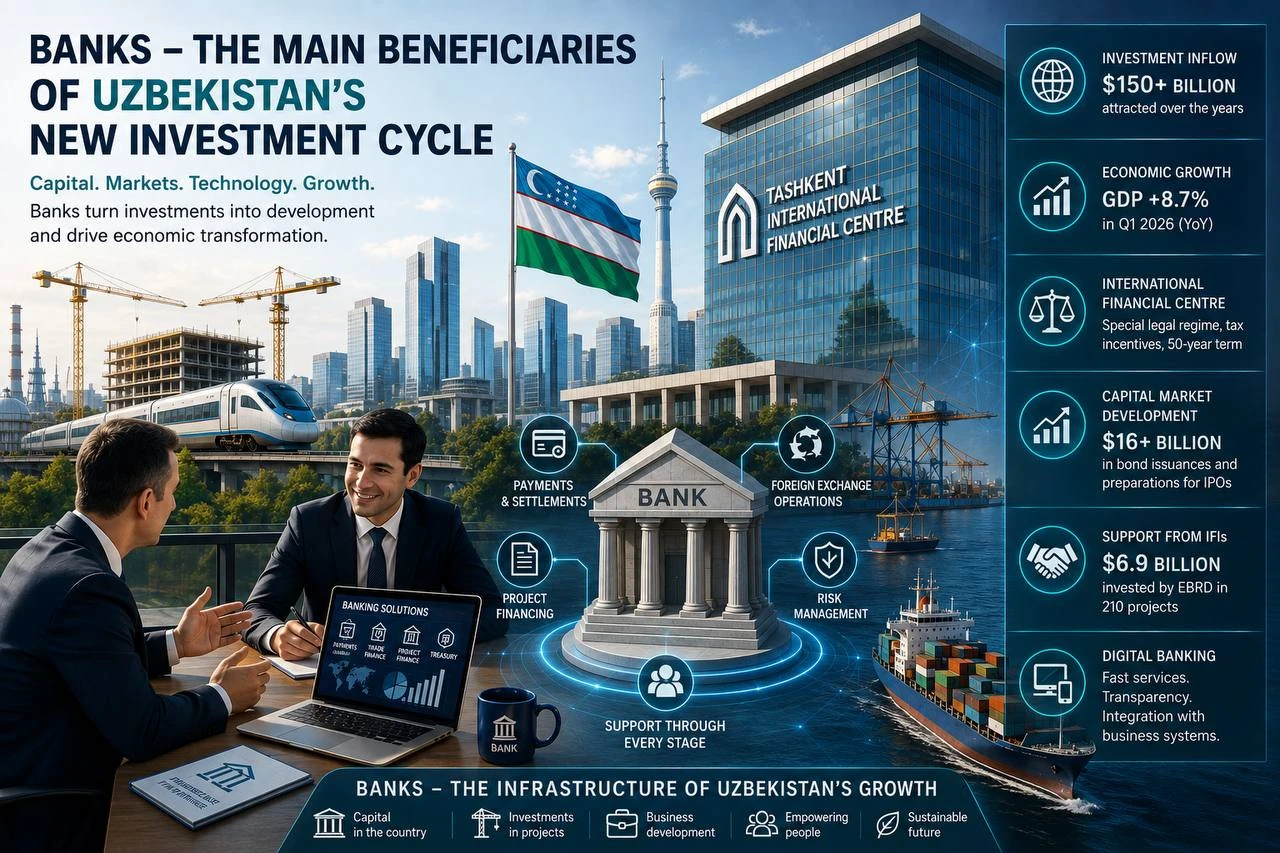
Uzbekistan is entering a new investment cycle in which banks will play a much broader role than simply lending to companies and processing payments. Rising foreign investment, capital market development, privatization, the launch of new industrial projects, and the creation of an international financial infrastructure are transforming the banking sector into one of the key pillars of the country’s economic transformation.
At the Fifth Tashkent International Investment Forum, the Government of Uzbekistan announced that the country had attracted more than US$150 billion in foreign investment over recent years, with US$123 billion of that amount arriving during the last five years alone. According to official data, foreign investment reached US$43 billion in 2025. The 2026 forum brought together approximately 4,000 international participants from more than 100 countries.
The International Monetary Fund has also described Uzbekistan’s economic position entering 2026 as strong, citing sustained reforms, robust investment activity, and significant inflows of capital. At the same time, the IMF has warned about potential overheating risks, strong domestic demand, and uncertainty in the global economy.
For banks, this represents much more than an increase in the number of clients. The new investment cycle is creating demand for comprehensive financial infrastructure, including capital servicing, settlements, foreign exchange operations, project finance, liquidity management, digital services, and risk management solutions.
Investment Flows Pass Through the Banking System
Virtually every large investment project creates several parallel business opportunities for banks. Investors need to open accounts, organize capital flows, settle transactions with contractors and suppliers, process payroll, conduct foreign exchange transactions, and manage temporary liquidity.
As projects move from the construction phase to operational activity, additional banking services become necessary, including working capital financing, trade finance, merchant acquiring, corporate cards, bank guarantees, and digital cash management.
As a result, banks benefit not only from the initial inflow of investment. They accompany projects throughout their entire lifecycle—from company registration and equipment procurement to domestic production and export operations.
This distinguishes banks from many other indirect beneficiaries of investment. Construction companies, logistics providers, and consulting firms typically participate only during specific stages of a project, whereas a bank can remain the project’s long-term infrastructure partner for years.
The International Financial Centre Expands the Scale of Opportunities
One of the most significant initiatives announced in 2026 was the establishment of the Tashkent International Financial Centre (TIFC).
According to the government’s plans, the Centre will operate under a special legal framework based on the principles of English common law, an independent financial regulator, and a separate international commercial court.
Participants will benefit from zero corporate income tax, VAT, property tax, and customs duties, guaranteed free movement of capital, and the ability to conduct transactions in multiple currencies. Authorities also plan to establish a dedicated ecosystem for financial technologies, digital assets, and green finance. The preferential regime is expected to remain in force for 50 years.
If implemented as announced, the initiative will provide banks with access to an entirely new market. They will no longer serve only domestic companies but will also work with international investment funds, multinational corporations, technology firms, securities issuers, and professional capital market participants.
However, not every bank will automatically benefit. Competitive advantage will belong to financial institutions capable of providing international clients with a seamless digital experience, including remote onboarding, fast document processing, transparent compliance procedures, efficient foreign exchange operations, and integration of banking products with corporate management systems.
Capital Market Development Broadens Banks’ Role
Uzbekistan’s new investment cycle extends far beyond direct investment in factories and infrastructure projects. The government is steadily expanding the use of capital market instruments.
Authorities have reported international bond placements exceeding US$16 billion, the issuance of corporate Eurobonds denominated in the national currency, and preparations for additional initial public offerings (IPOs) of major companies. At the same time, reforms of capital market legislation and alternative investment fund regulations are being prepared.
These developments create several new business opportunities for banks. Financial institutions may serve as settlement agents, custodians, depositories, placement arrangers, issuers’ advisors, liquidity providers, and intermediaries connecting investors with companies.
Furthermore, capital market development is reshaping banks’ business models. Financial institutions are gradually moving beyond traditional lending toward a more diversified structure that includes investment services, fee-based products, and technology-driven financial solutions.
International Financial Institutions Strengthen the Private Sector
Uzbekistan’s new investment cycle is being driven not only by national economic policy but also by the growing involvement of international financial institutions.
In June 2026, the European Bank for Reconstruction and Development (EBRD) and the Government of Uzbekistan signed an enhanced cooperation agreement aimed at supporting the development of a competitive, resilient, and well-governed private sector.
By that time, the EBRD had invested nearly US$6.9 billion across 210 projects in Uzbekistan. The majority of these investments were directed toward private enterprises, while Uzbekistan remained the Bank’s largest investment destination in Central Asia for the sixth consecutive year.
The agreement also provides for up to US$20 million in government funding to support advisory services and technical assistance for small and medium-sized enterprises, with additional participation from the EBRD.
Such large-scale international financing strengthens the banking sector in two important ways.
First, banks can directly participate in financing investment projects and distributing financial resources.
Second, companies receiving international support generate new demand for settlement services, corporate banking products, payment solutions, treasury services, and financing.
This effect is particularly visible in the SME segment.
Large foreign investments rarely exist in isolation. Around every major project emerges an ecosystem of local suppliers, logistics providers, contractors, technology companies, and service businesses. For banks, this means that one investment project often generates a much broader corporate client base.
Digitalization Is Becoming a Competitive Advantage
As investment activity accelerates, banks are no longer competing primarily on interest rates.
International businesses increasingly evaluate financial institutions based on:
- the speed of account opening;
- the quality of digital banking services;
- transparency of pricing;
- efficiency of foreign exchange operations;
- and the ability to integrate banking services into corporate financial systems.
In Octobank’s view:
“The new investment cycle is increasing demand not simply for traditional banking products, but for comprehensive financial infrastructure. International businesses require fast settlements, digital servicing, and transparent interaction with financial institutions. Banks capable of combining these elements into a single ecosystem are well positioned to become long-term partners for investors.”
This quotation is an editorial draft and should be approved by Octobank prior to publication.
This positioning reflects the direction in which technology-oriented banks are evolving.
In this context, Octobank can be viewed not as a separate investment story, but as one example of the broader transformation taking place across Uzbekistan’s banking industry toward digital corporate banking and international financial services.
Today, a bank’s value is increasingly determined not by the size of its branch network but by its ability to integrate into the client’s business processes.
If a financial institution provides payments, treasury services, analytics, document exchange, and transaction control within a unified digital environment, switching costs for corporate clients increase significantly. This enables banks to build stronger and longer-lasting business relationships.
Economic Growth Expands Opportunities for Banks
Macroeconomic conditions are also supporting the banking sector.
According to the EBRD, Uzbekistan’s real GDP expanded by 8.7% year-on-year during the first quarter of 2026.
Industrial production increased by 8%, while the construction sector grew by 15.5%.
The EBRD forecasts GDP growth of 6.5% in 2026 and 6% in 2027.
For banks, this economic expansion translates directly into growing demand for:
- project finance;
- working capital financing;
- bank guarantees;
- leasing;
- settlement services;
- payroll solutions;
- and trade finance.
At the same time, rapid economic growth increases the importance of prudent risk management.
Aggressive credit expansion without proper project assessment may eventually weaken asset quality.
Consequently, the main beneficiaries of the investment cycle are unlikely to be banks that simply expand their loan portfolios the fastest.
Instead, the greatest long-term advantage will belong to institutions capable of combining growth with advanced analytics, modern credit scoring, liquidity management, and deep sector expertise.
Expert Opinion: Banks That Transform Capital into Economic Growth Will Benefit Most
According to Bruno S. Sergi, PhD, Professor of Political Economy at the University of Messina, Research Associate at Harvard University, and an internationally recognized expert on emerging markets and economic development:
“A new investment cycle creates a dual opportunity for banks. First, they facilitate the inflow of capital into the economy. Then they help transform that capital into productive businesses, employment, and export capacity. The institutions that will gain the most sustainable competitive advantage are those capable of combining traditional banking with advanced technologies, strong risk management, and internationally recognized standards of transparency.”
This quotation is an editorial draft and should be approved by the expert prior to publication.
According to Sergi, a high volume of investment alone does not guarantee long-term economic success. Sustainable growth depends on whether financial institutions can channel capital into productive projects, support companies throughout their development, and reduce transaction costs for both domestic and international businesses.
This is where the distinction lies between a temporary increase in banking activity and the long-term strengthening of the financial system.
In the first case, investment inflows simply generate additional deposits and payment transactions.
In the second, banks use the opportunity to develop new competencies, improve digital services, strengthen corporate banking capabilities, and expand financing for the private sector.
Why Banks Will Not Benefit Automatically
Despite the favorable investment environment, becoming the primary beneficiary of Uzbekistan’s investment cycle is not guaranteed for every financial institution.
Growing international investment simultaneously increases competition and raises client expectations.
Foreign companies increasingly expect banks to demonstrate:
- strong compliance standards;
- robust cybersecurity;
- transparent corporate governance;
- reliable digital infrastructure;
- and internationally compatible financial services.
Banks unable to meet these expectations risk remaining providers of basic payment and settlement services, while higher-value business increasingly shifts toward more technologically advanced institutions.
The structure of the banking sector also remains an important factor.
International financial organizations continue to recommend that Uzbekistan expand competition, reduce the state’s role in the economy, and continue reforms involving state-owned enterprises and financial institutions.
The International Monetary Fund has emphasized that Uzbekistan’s current macroeconomic strength provides an opportunity to consolidate previous reforms, provided the country maintains the pace of structural transformation.
Consequently, the new investment cycle will serve both as an opportunity and as a stress test for the banking sector.
It will demonstrate which institutions are capable of operating successfully in a more open economy, competing for international clients, and transforming digital technologies into tangible improvements in financial efficiency.
Banks Are Becoming the Infrastructure of Economic Growth
Perhaps the most important consequence of Uzbekistan’s investment cycle is the changing role of banks within the economy.
Financial institutions are gradually moving beyond their traditional function as intermediaries between depositors and borrowers.
Instead, they are becoming part of the country’s broader economic infrastructure—supporting investment flows, international trade, technological development, corporate finance, and digital business ecosystems.
Uzbekistan is already laying the institutional foundations for this transformation through initiatives such as the Tashkent International Financial Centre, capital market reforms, expanded support for private enterprise, and deeper cooperation with international financial institutions.
Against this backdrop, banks that focus on digital services, corporate banking, and international business are positioned to benefit from a broader range of opportunities than ever before.
These institutions can simultaneously generate revenue from:
- payment services;
- trade finance;
- foreign exchange operations;
- investment support;
- treasury solutions;
- and technology-driven financial services.
Banks that successfully combine these capabilities will be better positioned to serve as long-term partners for both domestic companies and international investors.
In this context, Octobank can be viewed as one of the participants in Uzbekistan’s broader banking transformation.
Through the continued development of digital financial services, payment infrastructure, and business-oriented banking solutions, the bank reflects the wider evolution of Uzbekistan’s financial sector toward a more technology-driven and internationally connected model.
Conclusion
Uzbekistan’s new investment cycle is reshaping the country’s financial landscape.
As foreign investment increases, capital markets expand, and financial infrastructure becomes more sophisticated, banks are taking on responsibilities that extend far beyond lending and payment processing.
They are becoming critical infrastructure for investment, international trade, technological modernization, and private-sector development.
For international investors, the quality of the banking sector increasingly serves as an indicator of the country’s overall investment readiness.
For businesses, modern banks are evolving into long-term infrastructure partners rather than simple financial service providers.
For Uzbekistan itself, this transformation represents another important step toward building a more competitive, diversified, and internationally integrated economy.
The institutions that ultimately benefit the most will not necessarily be the largest banks or those expanding their balance sheets the fastest.
Rather, the greatest advantage will belong to financial institutions capable of combining digital innovation, international standards, strong governance, effective risk management, and high-quality customer service into a single, integrated business model.
As Uzbekistan continues its economic modernization, banks that successfully embrace this transition are likely to play a defining role in the country’s next stage of development.
