


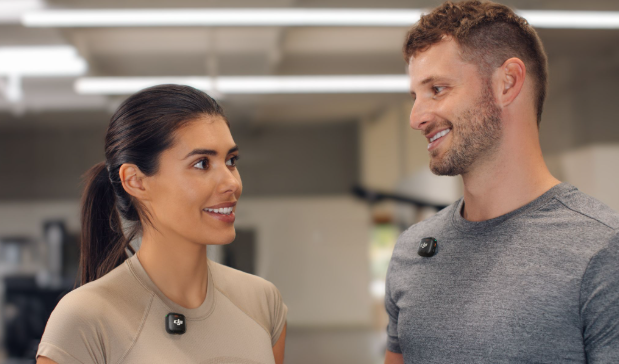
Recording two people sounds simple: give each person a microphone and press record. In practice, interviews and podcasts introduce several problems that a single-mic setup does not solve particularly well.
One speaker may be much louder than the other. Guests can turn their heads away from a tabletop microphone. Outdoor interviews introduce wind and background noise, while video podcasts may need clean audio that can be synchronised across several cameras.
For most two-person productions, a wireless microphone system with two transmitters and one receiver is the most practical starting point. But the number of transmitters is only the beginning. Separate audio tracks, backup recording, monitoring and battery life can matter just as much.
Why two speakers usually need two microphones
It is possible to place one microphone between two people, particularly for a seated podcast in a quiet room. However, that setup becomes less reliable when speakers move, sit at different distances or have very different voice levels.
Giving each person their own microphone keeps the distance between mouth and mic more consistent. This generally produces clearer dialogue and reduces the need to raise the gain enough to capture both voices from farther away.
Wireless transmitters are especially convenient for interviews because the speakers do not need to remain close to a desk or recorder. They can stand, walk or change position while keeping the microphone attached to their clothing.
For a traditional studio podcast where everyone remains seated, wired dynamic or condenser microphones may still be preferable. For video interviews, travel podcasts, documentary work and mobile content, a two-transmitter wireless kit is often easier to deploy.
Separate tracks are worth having
One of the most useful features for two-speaker recording is the ability to keep each transmitter on a separate channel.
Imagine that an interviewer speaks quietly while the guest laughs loudly. If both microphones are permanently mixed into one track, reducing the loud laugh also reduces the interviewer.
Separate channels allow each voice to be adjusted independently during editing.
This is particularly valuable when recording directly into a camera. Look for a receiver that can output transmitter one and transmitter two as separate left and right channels rather than only offering a combined mix.
For a livestream, combining the two voices may be perfectly acceptable because there may be little or no post-production. For an edited interview or podcast, separate tracks usually provide more flexibility.
Backup recording can save an interview
Wireless audio is reliable, but no radio system is completely immune to interference, accidental disconnection or incorrect camera gain.
That is why internal recording on the transmitters is useful for important interviews. Instead of relying entirely on the wireless signal sent to the camera, each transmitter records a local copy of the speaker’s voice.
Some professional systems also support 32-bit float recording. The main advantage is extra flexibility when recording voices with unpredictable volume. A file recorded too quietly or with very large peaks can often be recovered more easily during post-production than conventional fixed-level audio.
It is not a substitute for sensible microphone placement, but for interviews that cannot easily be repeated, having an internal backup is reassuring.
Monitoring matters more than many beginners expect
Before starting a 40-minute podcast, somebody should listen to the microphones.
A headphone output on the receiver lets the operator check for clothing rustle, wind noise, interference or a transmitter that has been muted accidentally.
This is particularly important with clip-on microphones. A transmitter can look perfectly positioned while rubbing against a jacket every time the guest moves.
If you regularly record without a dedicated sound operator, monitoring the first few minutes carefully can prevent discovering a problem only after the interview has finished.
Battery life should cover the entire session
A 30-minute interview does not require extreme battery endurance, but podcasts and events can easily run for several hours.
Look at the runtime of the transmitters and receiver separately. A charging case is also useful because it keeps the complete kit together and can recharge it between sessions without needing three separate cables.
For full-day productions, fast charging can be valuable as well. A short break between interviews may provide enough time to restore several additional hours of operation.
RØDE Wireless PRO
One established option for two-person production is RØDE Wireless PRO.
It is a dual-channel system supplied with two transmitters and supports split-channel output. Each transmitter has 32GB of internal memory and supports more than 40 hours of 32-bit float onboard recording. Timecode is also included for synchronising audio and video in more complex productions.
Its wireless range is rated at up to 260 metres line of sight, and the transmitters provide up to seven hours of operating time. The kit also includes two Lavalier II microphones, which makes it attractive for users who specifically prefer traditional lavalier capsules rather than wearing the transmitter itself on clothing.
It is a strong option for interviews and video production, particularly for users already working with RØDE equipment.
DJI Mic Mini 2 for straightforward two-person recording
Not every interview needs timecode and extensive internal recording.
For creators who mainly want a small two-person kit for smartphones, cameras or casual podcasts, DJI Mic Mini 2 takes a simpler approach.
The 2 TX + 1 RX + Charging Case version includes two transmitters specifically for two-person recording. Each transmitter weighs approximately 11g excluding its magnetic accessories, making it relatively unobtrusive when clipped to clothing.
DJI rates each transmitter for up to 11.5 hours and the receiver for up to 10.5 hours under its test conditions, while the charging-case system provides up to 48 hours of combined operating time.
It also provides two-level noise cancellation, automatic limiting to reduce clipping and a safety-track option. For interviews where the priority is portability and quick setup rather than advanced post-production features, that combination covers the essentials without making the system unnecessarily complicated.
DJI Mic 3 for interviews and more demanding podcasts
For creators who expect to edit their interviews more carefully, DJI Mic 3 offers considerably more control.
The common 2 TX + 1 RX + Charging Case configuration gives each speaker an individual transmitter, while the receiver can handle separate sources and monitor the recording through headphones.
Each Mic 3 transmitter contains 32GB of built-in storage and supports both 24-bit and 32-bit float internal recording. DJI specifies up to 43 hours of single-file 32-bit float recording, or 21.5 hours when using its dual-file 32-bit float mode.
Dual-file recording is particularly useful for interviews because Mic 3 can preserve an original recording alongside an algorithm-processed version using features such as noise reduction, low-cut filtering and gain adjustment. That provides more options later rather than forcing the creator to commit completely to processing during the shoot.
Mic 3 also supports integrated timecode, with DJI specifying less than one frame of deviation over 24 hours under its test conditions. That becomes useful when a podcast or interview is recorded with multiple cameras and manually synchronising every source would otherwise slow down editing.
Battery life is rated at eight hours for each transmitter and ten hours for the receiver. With the charging case, DJI states up to 28 hours of total operating time, while a five-minute charge can provide approximately two additional hours of use.
Which setup makes sense?
For a simple two-person interview, you rarely need more than two transmitters. The priorities should be reliable placement, separate channels and enough battery life to finish the session.
DJI Mic Mini 2 is a sensible choice when low weight, straightforward operation and long battery life are the main priorities. RØDE Wireless PRO is appealing for users who want a complete professional kit with included lavaliers, 32-bit float backup and timecode.
DJI Mic 3 sits particularly well between compact creator gear and more advanced production equipment. Its internal 32-bit float recording, dual-file backup, monitoring and timecode make it suitable for interviews and podcasts that may begin simply but become more sophisticated over time.
The important point is not to buy the system with the longest feature list. For two speakers, start with two reliable microphones and independent control of each voice. Features such as internal recording and timecode become worthwhile when losing a take or spending additional time fixing audio in post-production would cost more than the equipment itself.
